What Is Topical Authority? A Complete Guide to Ranking Higher on Google
Posted On: July 4, 2026
Reading Time: 11 min read
Share:


Keep Up with Marketing Trends
Get the weekly newsletter
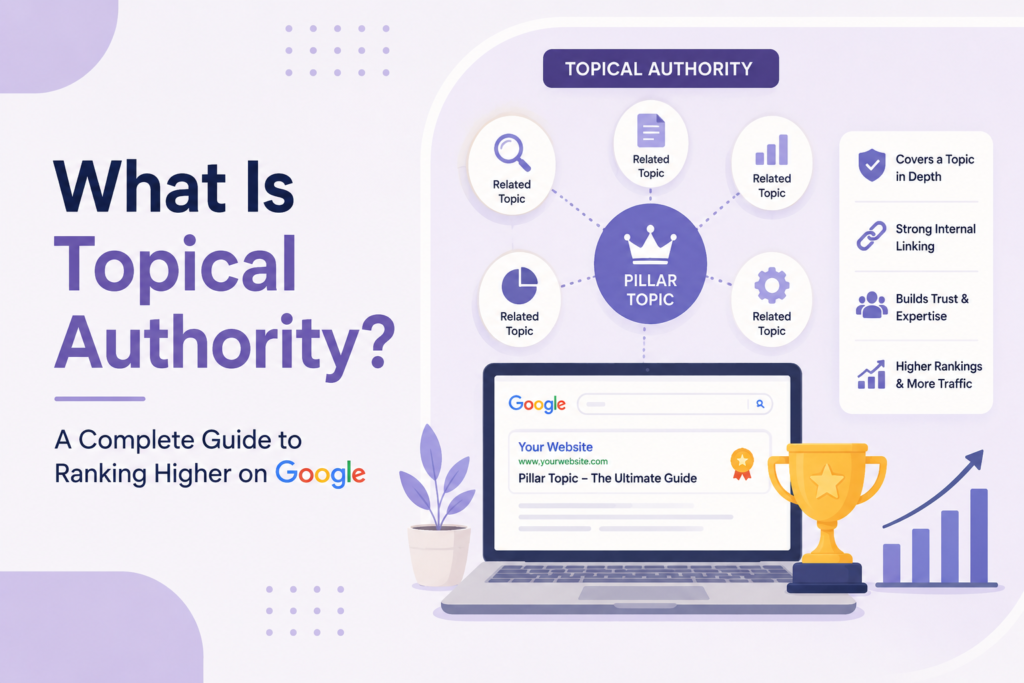
Table of Contents
- What Is Topical Authority?
- Why Does Topical Authority Matter for Your Website?
- Want to build topical authority for your business?
- How Does Google Know You’re an Expert?
- Create Topic Clusters Instead of Random Blogs
- Write for People First, Then Think About SEO
- Quality Always Wins Over Quantity
- Don’t Ignore Internal Linking
- Keep Your Content Fresh
- Build Trust, Not Just Rankings
- User Experience Also Matters
- Common Mistakes People Make While Building Topical Authority
- Building Topical Authority Takes Time
- Final Thoughts
- Start Building Your Topical Authority Today
- Frequently Asked Questions!
Have you ever searched for something on Google and noticed that the same websites keep appearing for almost every related question?
For example, when you search about digital marketing, websites like HubSpot, Semrush, and Moz often appear at the top. That’s not by chance. Google sees these websites as trusted sources because they have shared helpful content on the topic for a long time.
This is what topical authority is all about.
The good news is that you don’t have to be a large company to build topical authority. Whether you’re a small business owner, blogger, freelancer, student, or someone learning SEO, you can become a trusted source by creating content that genuinely helps people.
In this guide, we’ll explain topical authority in the simplest way possible, why it matters for your website, and how you can start building it today.
What Is Topical Authority?
Think of topical authority like becoming the “go-to person” for a particular subject.
Imagine you have a friend who knows everything about photography. Whenever you want advice on cameras or editing, you naturally ask them because you trust their knowledge.
Google works in a similar way.
If your website consistently publishes useful, high-quality content around one topic, Google starts recognizing your website as a reliable source. As a result, your pages have a better chance of appearing higher in search results.
For example, if your website is about digital marketing, instead of writing just one article on SEO, you should cover related topics such as:
- Keyword Research
- On-Page SEO
- Technical SEO
- Content Marketing
- Local SEO
- Link Building
- Google AI Updates
The more complete your content is, the stronger your topical authority becomes.
Keypoints: Topical authority isn’t about writing more, it’s about writing comprehensively. One well-structured content cluster on a single topic outperforms dozens of scattered, unrelated articles.
If you’re new to content planning, Google’s own Google Search Central provides useful guidance on creating helpful, people-first content.
Why Does Topical Authority Matter for Your Website?
Today’s Google isn’t just looking for pages with the right keywords.
It wants to recommend websites that genuinely help users.
When Google sees that your website covers a topic in depth, it starts trusting your content more.
This can help you:
- Rank higher on Google
- Attract more organic visitors
- Build trust with readers
- Increase engagement
- Improve your website’s long-term SEO performance
At Hapx Digital, we believe successful SEO isn’t about finding shortcuts. It’s about building trust over time through valuable content and smart strategies. Our SEO Services focus on helping businesses create content that delivers long-term results instead of chasing temporary rankings.
Want to build topical authority for your business?
HapxDigital can help you get there.
How Does Google Know You’re an Expert?
Google doesn’t publish a score that says, “Your topical authority is 90 out of 100.”
Instead, it looks at different signals to understand whether your website deserves to rank.
Some of these signals include:
- Helpful and original content
- Articles covering related topics
- Good internal linking
- User engagement
- Content freshness
- Quality backlinks
- Positive user experience
Think of it like building your reputation in real life.
People trust you when you consistently provide useful advice. Google does exactly the same with websites. Google’s Search Central documentation offers useful guidance on what “helpful, people-first content” actually means in practice — worth reading if you want to understand exactly what signals Google is looking for.
Create Topic Clusters Instead of Random Blogs
One of the easiest ways to build topical authority is by creating topic clusters.
Instead of publishing random blogs every week, choose one main topic and create several related articles around it.
Let’s say your main topic is SEO.
Your content cluster could include:
- Beginner’s Guide to SEO
- What Is Keyword Research?
- Technical SEO Explained
- On-Page SEO Checklist
- Local SEO Tips
- How Google AI Mode Is Changing SEO
- Common SEO Mistakes Beginners Make
Each article answers a specific question while linking naturally to the others. Readers stay on your site longer. Google understands your content is deeply connected. Everyone wins.
Tip: Start with your pillar page- a comprehensive overview of your main topic, then build supporting articles around each subtopic it mentions. This gives you a clear publishing roadmap and ensures every piece of content has a logical home within your site structure.
Building topic clusters becomes much easier when you have a clear Content Marketing Strategy. You can also explore our article, The Future of Content Marketing, to learn how combining AI with thoughtful planning can help you create content that stays relevant for years instead of weeks.
Write for People First, Then Think About SEO
One of the biggest mistakes people make is writing only for search engines.
Years ago, some websites repeated the same keyword dozens of times just to rank higher.
That doesn’t work anymore.
Today, Google is smart enough to understand natural language.
Instead of asking:
“How many times should I use my keyword?”
Ask yourself:
“Will someone leave this page feeling like their question has been answered?”
That’s the mindset Google is trying to incentivise. Put it into practice by:
- Using plain, accessible language
- Explaining complex ideas with real-world examples
- Breaking up long paragraphs for easier reading
- Avoiding unnecessary jargon
- Writing as if you’re explaining the topic to a knowledgeable friend
Keypoints:If your content genuinely answers the question better than any competing page, you’re already doing most of the work. SEO optimisation at that point becomes a finishing layer, not the foundation.
Quality Always Wins Over Quantity
Many people believe they need hundreds of blog posts to rank on Google.
That’s simply not true.
Imagine two websites:
Website A
- 150 short blogs
- Repeated information
- Little value for readers
Website B
- 20 detailed articles
- Practical examples
- Helpful visuals
- Easy-to-follow explanations
Which website would you trust more?
Most people would choose Website B.
Google usually does too.
One useful article that genuinely helps readers is often worth far more than five articles written just to target keywords.
Instead of asking,
“How many blogs should I publish?”
Ask,
“How can I make this article the best answer to someone’s question?”
That small shift in thinking can make a huge difference over time.
Don’t Ignore Internal Linking
Think of your website as a library.
Every blog, service page, or guide is like a different book on the shelf. If none of those books are connected, visitors and even Google may find it difficult to explore your content.
That’s where internal linking comes in.
Whenever you write a new blog, link it to other relevant pages on your website. This helps readers discover more useful information and also helps search engines understand how your content is connected.
For example, if someone is reading this article about topical authority, they may also be interested in learning about SEO strategy, content marketing, or website performance.
You can naturally guide them to helpful resources like SEO Services, The Role of Analytics in Digital Marketing, or The Future of Content Marketing. These links improve the user experience while strengthening your website’s overall content structure.
Keep Your Content Fresh
Building topical authority doesn’t end after publishing a blog.
Google prefers websites that keep their content updated.
Think about it this way: if you read an article about SEO from five years ago, there’s a good chance some of the information is outdated. Search engines evolve constantly, and so should your content.
Every few months, review your existing blogs and ask yourself:
- Is the information still accurate?
- Can I add new examples?
- Have there been any major Google updates?
- Are there new blogs I can link to?
Updating old content is often easier than writing a brand-new article, and it can have a positive impact on your rankings.
Build Trust, Not Just Rankings
Topical authority isn’t only about writing more content.
It’s about becoming a trusted source.
When readers trust your content, they spend more time on your website, share your articles, and come back for more.
Google notices these positive signals.
You can build trust by:
- Writing original content.
- Using simple language.
- Sharing practical examples.
- Linking to reliable sources.
- Keeping your information updated.
- Being honest and transparent.
If you’re wondering how Google evaluates high-quality content, the Google Search Central documentation offers valuable guidance on creating helpful, people-first content.
You can also learn how industry experts approach topical authority through Semrush’s guide to topical authority, which explains how comprehensive content helps improve visibility over time.
User Experience Also Matters
Imagine finding a helpful blog, but it takes 10 seconds to load.
Or the text is difficult to read on your phone.
Most people would leave the page within seconds.
That’s why topical authority goes hand in hand with user experience.
A fast, well-organized website makes it easier for people to find the information they need and easier for Google to crawl your pages.
At Hapx Digital, we often talk about creating websites that are both user-friendly and search-engine-friendly. Our insights on The Rising Importance of UX, Site Speed & Structural SEO explain why technical improvements play an important role in long-term SEO success.
Remember, great content deserves a great user experience.
Tip: A slow or poorly structured website limits the impact of even your best content. Technical SEO and content quality need to work together, neither delivers its full potential without the other.
Common Mistakes People Make While Building Topical Authority
Most websites that struggle to build topical authority are making one or more of these errors:
- Publishing across too many unrelated topics. Writing about everything makes it impossible for Google to understand what your website is actually about. Choose a niche and go deep.
- Writing primarily for keywords. Keywords guide your content planning — they shouldn’t dictate how every sentence is written. Your readers come first.
- Ignoring internal links. Every new article is an opportunity to strengthen your content network. Don’t leave those connections unmade.
- Never updating old content. SEO isn’t a publish-and-forget task. Older articles that are refreshed regularly continue to drive traffic for years.
- Forgetting the reader. Before hitting publish, ask: “Will this genuinely help someone?” If the honest answer is yes, you’re on the right tr
Building Topical Authority Takes Time
Many people expect SEO results overnight.
Unfortunately, that’s not how it works.
Think of topical authority like building a good reputation.
You don’t earn trust in a single day, you earn it by consistently showing up, sharing valuable knowledge, and helping others.
The same applies to your website.
Every helpful article you publish becomes another step toward becoming a trusted source in your industry.
Over time, those small efforts add up.
Google begins to understand your expertise.
Readers begin to trust your content.
And your website starts attracting more qualified visitors.
Final Thoughts
Topical authority isn’t about writing hundreds of blog posts or trying to trick Google’s algorithm.
It’s about becoming genuinely helpful.
When you focus on answering your audience’s questions, creating content around related topics, and keeping your information up to date, you’re building something much more valuable than rankings you’re building trust.
Whether you’re running a business, starting a blog, or learning SEO for the first time, remember that every great website begins with one helpful piece of content.
At Hapx Digital, we believe the best SEO strategy is one that puts people first. When your content solves problems, provides value, and connects naturally with your audience, better rankings often follow.
So instead of asking, “How can I rank higher on Google?”
Try asking, “How can I help my audience better today?”
That’s where real topical authority begins.
Start Building Your Topical Authority Today
If you’re ready to turn your website into a trusted resource in your industry, HapxDigital can help you build the content strategy and SEO foundation to make it happen.
Frequently Asked Questions!
What is topical authority in SEO?
Topical authority is the level of trust Google gives your website based on how well you cover a specific topic through high-quality, helpful content.
How do I build topical authority?
Start by choosing one main topic, create several related articles, connect them using internal links, and update your content regularly.
Does topical authority help improve Google rankings?
Yes. Websites that consistently publish useful content around one subject are more likely to rank for related keywords and attract organic traffic.
Is topical authority only important for large websites?
Not at all. Small businesses, bloggers, startups, and even personal websites can build topical authority by consistently publishing valuable content within their niche.
How many articles do I need to build topical authority?
There’s no fixed number. Focus on creating comprehensive, high-quality content rather than publishing a large quantity of articles.
How long does it take to build topical authority?
It depends on your industry, competition, and content quality. For most websites, building strong topical authority is a gradual process that can take several months of consistent effort.
What’s the difference between topical authority and domain authority?
Domain authority is a third-party metric that estimates a website’s overall strength, while topical authority refers to how knowledgeable and trustworthy your website appears to Google on a specific subject.