What Makes Content “High-Quality” in Google’s Eyes?
Posted On: April 25, 2026
Reading Time: 5 min read
Share:


Keep Up with Marketing Trends
Get the weekly newsletter
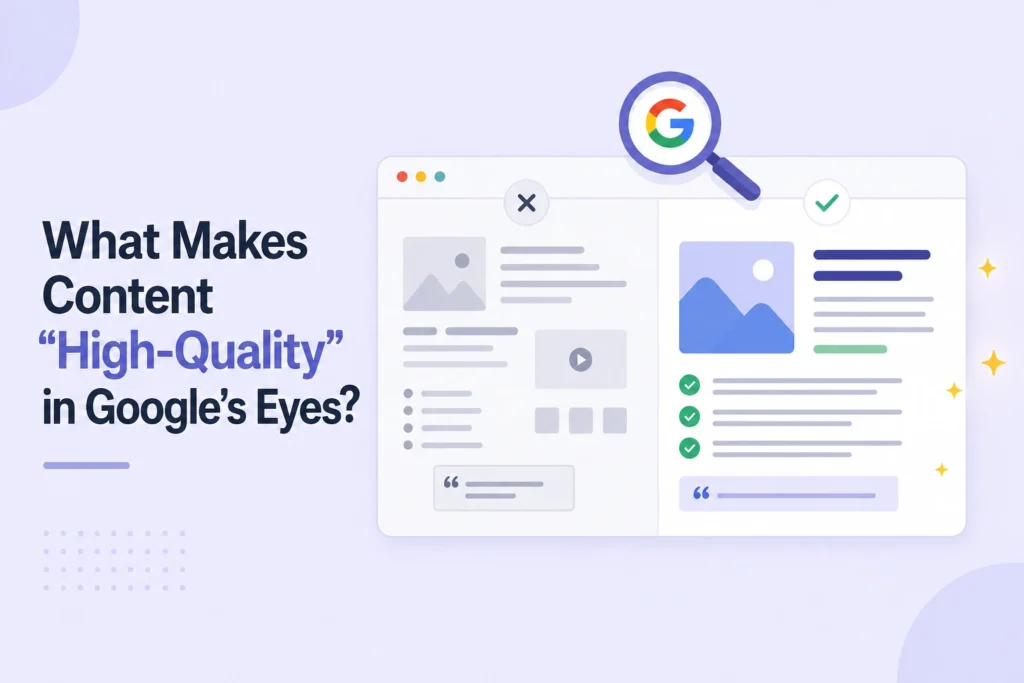
Table of Contents
- What Google Is Actually Looking For
- 1. It Actually Answers the Question
- 2. It Shows Real Expertise (E-E-A-T)
- 3. It’s Built for Humans, Not Bots
- 4. It Loads Fast and Works on Mobile
- 5. People Actually Stay on the Page
- 6. Other Sites Want to Link to It
- Quick Content Quality Checklist
- Bottom Line
- Need help building a content strategy that actually ranks?
- FrequentlyAsked Questions!
Let’s be honest- everyone says “just create high-quality content” like it’s the most obvious thing in the world.
But what does high-quality actually mean to Google?
Because spoiler: it’s not about writing the longest blog post or stuffing your page with keywords. Google’s gotten a lot smarter than that. And if your content isn’t hitting the right signals, you’re invisible, no matter how good your writing is.
Let’s break it down, simply.
What Google Is Actually Looking For
Google’s whole job is to find the best answer for its users. That’s it. So when it ranks your content, it’s asking one question:
“Does this page genuinely help the person searching?”
Everything else flows from that.
1. It Actually Answers the Question
This sounds obvious, but you’d be surprised how many pages beat around the bush, bury the answer under five paragraphs of fluff, or just… never really answer what the user came for.
Google wants content that:
- Matches the search intent (informational, transactional, navigational)
- Gets to the point without unnecessary filler
- Covers the topic thoroughly — not exhaustively, but completely
Key point: If someone Googles “how to fix a slow website,” they want fixes- not a 400-word intro about why website speed matters.
2. It Shows Real Expertise (E-E-A-T)
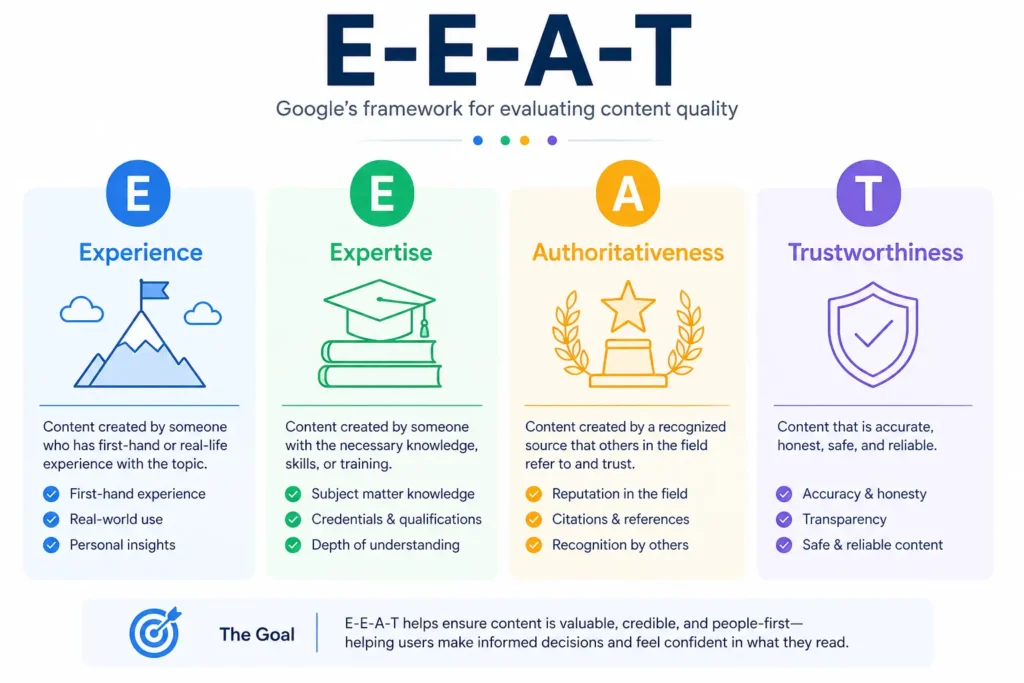
Google’s quality guidelines revolve around a framework called E-E-A-T — Experience, Expertise, Authoritativeness, and Trustworthiness.
Here’s what that looks like in practice:
- Experience → First-hand knowledge, real examples, case studies
- Expertise → Content written by (or attributed to) someone who actually knows the subject
- Authoritativeness → Is your site or author recognized in the niche?
- Trustworthiness → Accurate info, proper sources, no shady stuff
What to do:
- Add author bios with credentials
- Cite reliable sources
- Share real results or examples from your own work
- Keep your content updated — outdated facts kill trust
3. It’s Built for Humans, Not Bots
Keywords still matter. But keyword stuffing? That’s a 2010 strategy and Google hates it now.
High-quality content flows naturally. It uses:
- Your primary keyword in the title, intro, and a few headers
- Related terms (LSI keywords) naturally throughout the body
- Clear headings that help readers scan and navigate
- Short paragraphs that don’t scare people off
Key point: If your content reads like it was written for a robot, Google will notice. So will your readers — and they’ll leave.
4. It Loads Fast and Works on Mobile
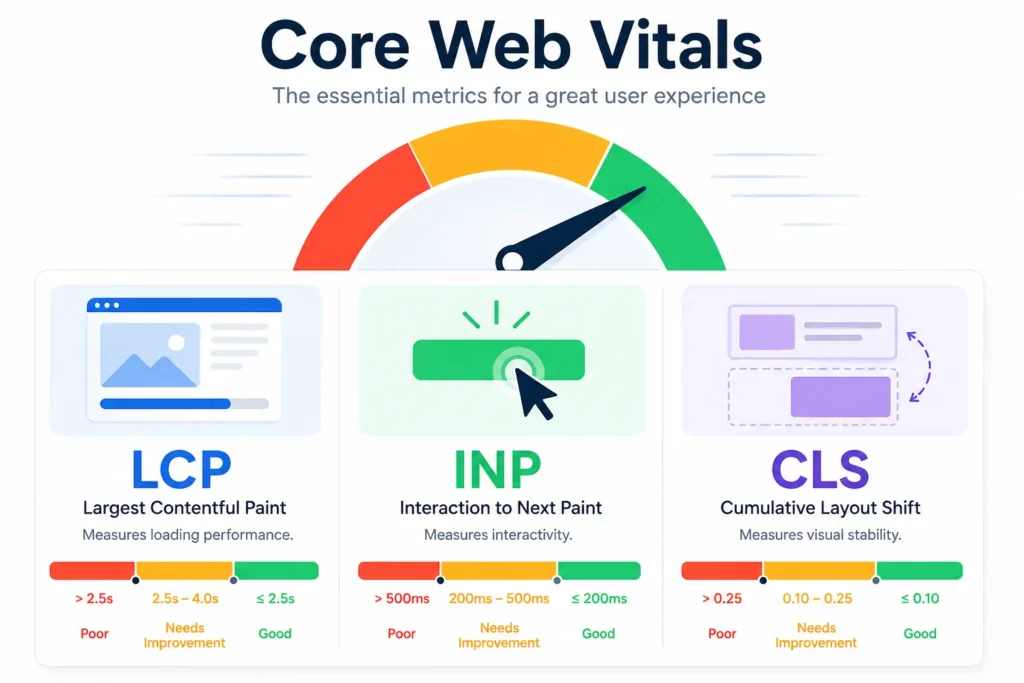
This is the part people forget. Content quality isn’t just about the words, it includes the experience of reading those words.
Google’s Core Web Vitals measure:
- How fast your page loads (LCP)
- How quickly it responds to interaction (INP)
- How stable the layout is while loading (CLS)
Callout: If your page loads in 6 seconds on mobile, it doesn’t matter how brilliant the content is. Users bounce. Google sees the bounce. Rankings drop.
What to do:
- Compress images
- Use a fast, reliable hosting provider
- Make sure your site is fully responsive on mobile
5. People Actually Stay on the Page
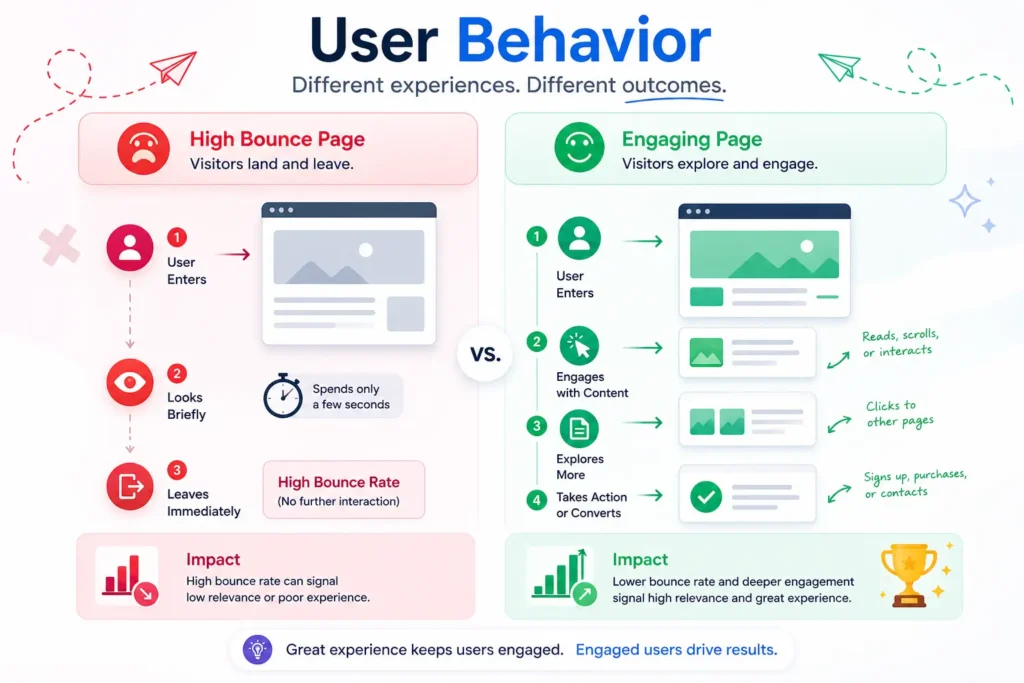
Google watches behavior signals — how long people stay on your page, whether they scroll, whether they click back immediately.
High bounce rates and low time-on-page tell Google: “this content didn’t satisfy the user.”
How to keep people engaged:
- Use a strong intro that hooks immediately
- Break content into easy-to-scan sections
- Add visuals — images, infographics, videos where relevant
- Include internal links to related content
- End with a clear next step (CTA, related post, contact)
6. Other Sites Want to Link to It
Backlinks are still one of Google’s strongest ranking signals. And the best way to earn them? Create content worth linking to.
This means:
- Original research or data
- Comprehensive guides that become a go-to reference
- Unique insights that aren’t just a rehash of what’s already out there
- Tools, templates, or resources people genuinely find useful
Key point: Content that only says what everyone else is already saying doesn’t earn links. Be the source, not the echo.
Quick Content Quality Checklist
Before you hit publish, run through this:
- ✅ Does the content fully answer the search intent?
- ✅ Is it written with genuine expertise or credited to someone who has it?
- ✅ Does it read naturally — no keyword stuffing?
- ✅ Are headings clear and easy to scan?
- ✅ Is the page fast and mobile-friendly?
- ✅ Is there a clear CTA or next step?
- ✅ Would another website genuinely want to link to this?
If you’re checking all seven boxes, you’re in good shape.
Bottom Line
High-quality content isn’t just well-written content. It’s intentional content — designed to serve a real person with a real question, built on genuine expertise, and delivered in a way that makes the experience effortless.
Google’s algorithm has evolved, but the goal hasn’t: the best answer wins.
So before your next piece goes live, ask yourself: is this genuinely the best answer for someone searching this topic? If yes, you’re on the right track. If not, go back and make it better.
Need help building a content strategy that actually ranks?
At Hapx Digital, we mix SEO smarts with content that connects — designed with intent, built for impact
Frequently
Asked Questions!
How long should high-quality content be?
There’s no magic number. It should be as long as it needs to be to fully answer the question — no more, no less. Some queries are satisfied with 500 words. Others need 2,000+. Match the depth to the intent.
Does Google penalize AI-generated content?
Google doesn’t penalize AI content outright, it penalizes low-quality, unhelpful content regardless of how it was made. If AI-assisted content is accurate, original, and genuinely useful, it can rank. If it’s generic and hollow, it won’t.
How often should I update existing content?
For fast-moving topics, review every 3–6 months. For evergreen content, a yearly update is usually enough to keep it fresh and accurate.
What’s the most important E-E-A-T factor?
Trustworthiness. Google sees it as the foundation. Without it, expertise and authority don’t count for much. Make sure your content is accurate, transparent, and backed by credible sources.