Social Media Management vs Social Media Marketing: What’s the Real Difference?
Posted On: September 1, 2026
Reading Time: 8 min read
Share:


Keep Up with Marketing Trends
Get the weekly newsletter
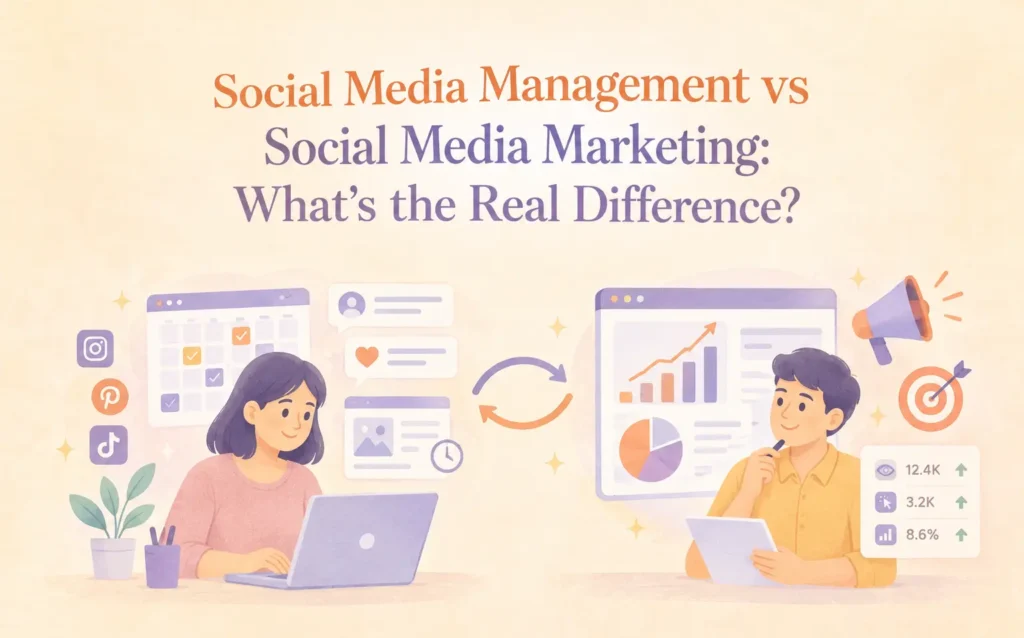
Table of Contents
- So, What’s Actually Different Here?
- Social Media Management, In Plain Terms
- Social Media Marketing, In Plain Terms
- The Quick Side by Side
- Why People Mix These Up So Often
- Which One Does Your Business Actually Need?
- The Real Answer: You Need Both, Just Not Equally
- 3 Quick Tips Before You Hire Anyone
- Not Sure Where to Start?
- Frequently Asked Questions
If you have ever asked an agency for “social media help” and gotten back two completely different proposals, you are not alone. One quote is all about content calendars, captions, and community replies. The other is packed with ad budgets, targeting, and conversion goals. Same starting question, two very different answers.
That is because social media management and social media marketing are not the same thing, even though most people use the terms like they are interchangeable. One keeps your brand present and likeable. The other makes it grow. Mixing them up usually means you end up paying for one when you actually needed the other, or worse, you get neither working properly.
Let us break down what each one actually does, where they overlap, and how to figure out what your brand needs right now.
So, What’s Actually Different Here?
Here is the short version before we go deeper: social media management is about showing up consistently and building relationships. Social media marketing is about using that presence to hit specific business goals, like traffic, leads, or sales.
Think of it like running a shop. Management is keeping the shelves stocked, the lights on, and greeting every customer who walks in. Marketing is the campaign that gets more people walking through that door in the first place. You genuinely need both, they just do different jobs.
Social Media Management, In Plain Terms
Social media management is the day to day work of keeping your brand active and human on platforms like Instagram, LinkedIn, and Facebook. It is less about big campaigns and more about steady, reliable presence.
What that usually includes:
- Planning and building out a content calendar so you are not scrambling for a caption at 11pm
- Creating posts, reels, and stories that actually sound like your brand
- Replying to comments and DMs (the unglamorous part that matters most)
- Keeping profiles updated and on-brand across every platform
- Tracking engagement so you know what is landing and what is not
The goal here is not a spike in sales this week. It is trust, built one post and one reply at a time. Done right, it makes your brand feel like a real, responsive presence rather than a logo that posts occasionally and disappears.
Social Media Marketing, In Plain Terms
Social media marketing is the strategic, goal-driven side. It uses your social platforms to move people toward a specific outcome, whether that is website visits, sign ups, or sales.
What that usually includes:
- Paid ad campaigns with defined targeting and budgets
- Boosted posts built around a specific offer or launch
- Funnel thinking, getting someone from a scroll to a click to a conversion
- A/B testing creative, copy, and audiences to see what actually converts
- Reporting tied to ROI, not just likes
This is the part where “vanity metrics” stop mattering as much and cost per lead, click-through rate, and conversion rate take over. Marketing treats social platforms less like a community space and more like a growth channel.
Pro Tip: If your team can answer “what did that post achieve for the business” with a number, not a feeling, that content probably falls under marketing. If the honest answer is “it kept us visible and consistent,” that is management doing its job.
The Quick Side by Side
| Social Media Management | Social Media Marketing | |
| Main goal | Consistency, brand voice, community | Leads, traffic, conversions, sales |
| Approach | Organic, ongoing, relationship-first | Campaign-driven, often paid |
| Day to day work | Posting, replying, scheduling, monitoring | Ad creation, targeting, testing, reporting |
| Success looks like | Engagement, followers, response time, sentiment | ROI, cost per lead, click-through rate |
| Timeline | Always on | Runs in campaigns with a start and end |
Why People Mix These Up So Often
Honestly, it is not confusing because people are not paying attention, it is confusing because the two genuinely overlap. A social media manager often writes the organic caption that later gets boosted into a paid ad. A marketer relies on the community trust that management already built to make that ad convert better. On paper they are different disciplines, in practice they are constantly feeding into each other.
Where it gets messy is when a business only budgets for one and expects the results of both. Posting three times a week without any paid push will keep you visible, but it will not reliably generate leads on its own. Meanwhile, running ads on a page that never replies to comments or looks abandoned tends to hurt conversion rates instead of helping them, because people check your recent activity before they trust an ad enough to click.
Which One Does Your Business Actually Need?
A few honest questions to ask yourself:
- Are you trying to build trust and stay top of mind, or are you trying to hit a number this quarter? If it is the former, lean into management. If it is a specific, measurable target like signups or sales, you need marketing in the mix.
- Do you already have decent engagement but flat conversions? That usually means your management is working, and it is time to layer in marketing to actually convert that attention.
- Is your page inconsistent, or does it look inactive? No amount of ad spend fixes that well. Get management sorted first, since it is the foundation everything else sits on.
- Do you have a specific launch, offer, or event coming up? That is a marketing job, built around a defined campaign and timeline, not an ongoing content calendar.
The Real Answer: You Need Both, Just Not Equally
Very few brands that are actually growing on social are relying on only one of these. The realistic split usually looks like:
Management runs constantly, keeping the brand active, responsive, and consistent every single week.
Marketing runs in focused bursts, campaigns tied to a launch, a sale, or a specific growth goal, built on top of the presence management has already established.
A new café, for example, needs consistent social media management from day one just to build an audience and look like a real, active business. Once that foundation is there, targeted performance marketing campaigns can push specific offers, like a launch week deal or a seasonal menu, to convert that audience into actual footfall.
Pro Tip: Do not launch paid campaigns on a page that has been quiet for months. Spend two to three weeks getting your organic presence active and consistent first, then bring in paid marketing on top of it. It genuinely performs better that way.
3 Quick Tips Before You Hire Anyone
- Ask what “success” means in their proposal. If an agency cannot tell you whether they are optimizing for engagement or for conversions, that is a red flag. The two need different strategies, and a proposal that blurs them usually means neither gets done properly.
- Check if your content and ads are actually talking to each other. Your organic posts and paid campaigns should share the same voice and visuals. Disconnected strategies confuse your audience and waste budget.
- Do not judge management by marketing metrics. A great community management job will not always show up as a sales spike, and that is fine. Judge each discipline by what it is actually built to do.
Not Sure Where to Start?
Whether you need someone showing up for your brand every day, campaigns that actually convert, or both working together, that is exactly what we help businesses figure out.
Frequently Asked Questions
Is social media management the same as social media marketing?
No. Management focuses on the ongoing, organic side of your brand’s presence, posting, replying, staying active. Marketing is more campaign-driven and typically paid, aimed at specific outcomes like traffic or leads. They work together, but they are not the same service.
Can a small business do social media management without marketing?
Yes, and many do, especially early on. Consistent organic management builds an audience and brand presence over time. It just tends to grow more slowly without paid marketing layered on top, since organic reach on most platforms has gotten more limited over the years.
Do I need to hire two different people for this?
Not necessarily. Many agencies, including us, handle both under one roof so your organic content and paid campaigns stay aligned instead of working against each other. What matters more than headcount is making sure both disciplines are actually being covered.
Which one is more important for a new brand?
Generally, management comes first. A brand new page needs a consistent, active presence before ads make sense, since paid traffic landing on an inactive-looking profile tends to convert worse. Once that foundation exists, marketing accelerates growth on top of it.
How much does social media management cost compared to marketing?
Management is usually a flat monthly retainer covering content and day to day handling. Marketing costs vary more, since it includes ad spend on top of strategy and management fees. The right mix really depends on your goals and current stage of growth.
Can I switch between the two, or do I need both running all the time?
Management is generally meant to run continuously, since consistency is the whole point. Marketing works well in focused bursts, campaigns tied to launches, offers, or specific goals, rather than running non-stop.